

A garden office does not, by itself, determine the tax position when you sell your home. Whether capital gains tax on a garden office in the UK may apply depends on ownership, how the space was used and whether the property qualifies for Private Residence Relief.
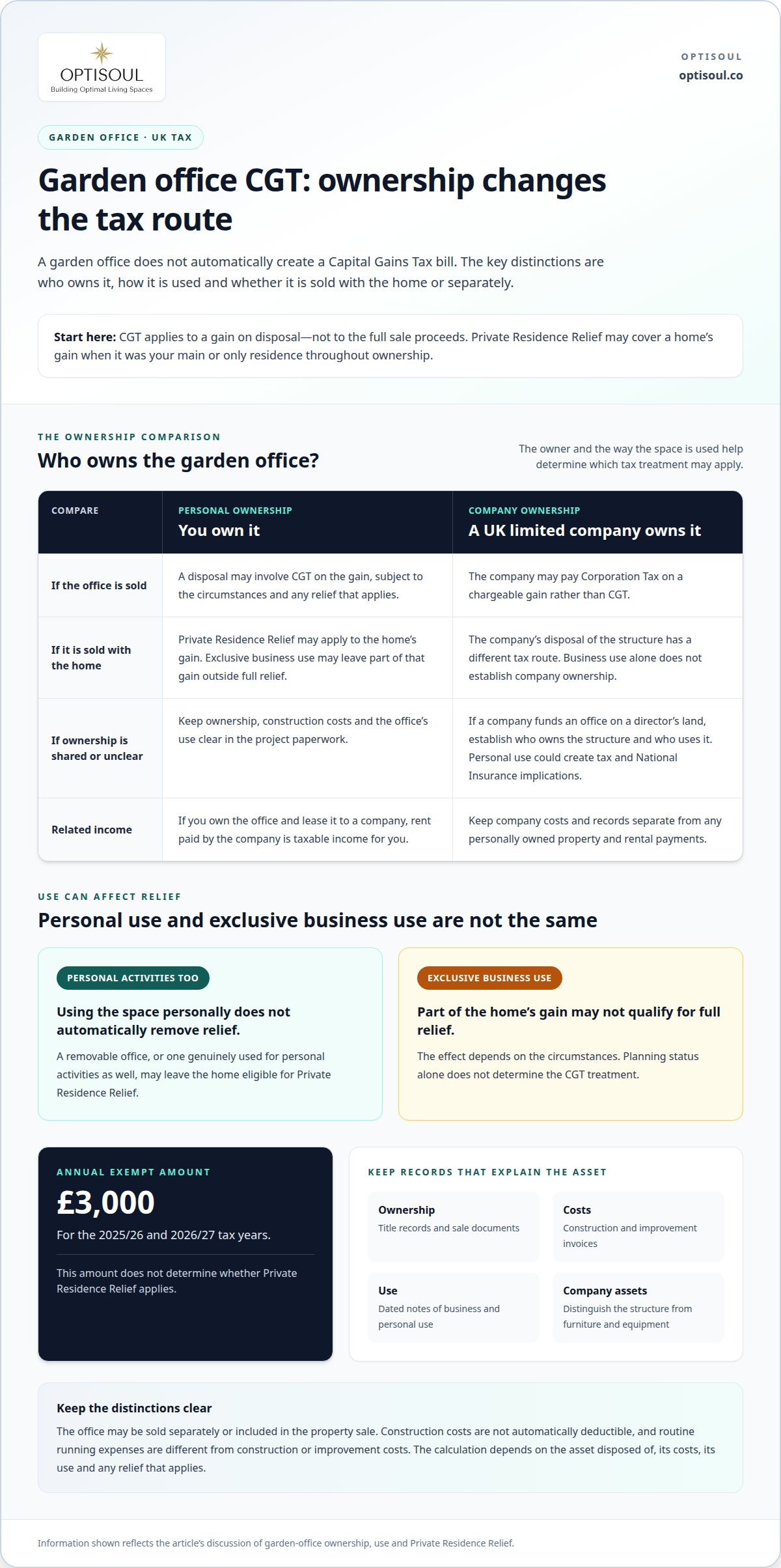
Capital Gains Tax applies to the profit on disposal, not the sale proceeds. A main or only home occupied as such throughout ownership qualifies for Private Residence Relief, while exclusive business use of a garden office may leave part of the gain outside full relief. HMRC sets the annual exempt amount at £3,000 for 2025/26 and 2026/27, but this does not determine whether relief applies. This guide explains what CGT means, how personal and business use can affect relief, and why ownership matters when a garden office or property is sold.
Key Takeaways
- Separate the sale of the garden office from the sale of the property to understand which disposal may create a taxable gain.
- Consider how exclusive business use, personal use and the permanence of the structure could affect Private Residence Relief.
- Where a limited company owns and sells the office, the tax treatment differs from a personally owned garden room.
- Shape a bespoke garden office around its intended use and your property with Optisoul Garden Rooms and Outdoor Living Spaces.
Capital Gains Tax and Private Residence Relief
Capital Gains Tax (CGT) applies to the profit when an asset that has increased in value is disposed of. For a home, Private Residence Relief can cover the gain if it was your main or only residence throughout ownership. The relief is set out in TCGA 1992 ss222-226. HM Revenue & Customs sets the annual capital gains exemption at £3,000 for the 2025/26 and 2026/27 tax years.
Using a garden office partly for personal activities does not automatically remove relief. Exclusive business use is different: the part of a home’s gain relating to business use may not qualify for full relief. A removable office, or one genuinely used for personal activities too, may leave the home eligible for relief. Keep clear records of business and private use.
Planning status alone does not determine CGT treatment. Ownership, use and the effect on the property’s value also matter. A separate title can help clarify who owns the office and whether it is sold with the home or separately. Keep purchase and sale documents, construction invoices, plans, title records and dated notes of business and personal use. These records help explain the asset, its costs and how it was used when calculating a gain or supporting a relief claim.
Employee homeworking tax relief is separate from CGT. Working from a garden office does not, by itself, establish that the space is used exclusively for business; employee eligibility depends on working arrangements. Capital allowances concern eligible items such as some fixtures, not the CGT relief on a residential home. Business rates are also separate: according to UK Government, small business rates relief may apply to a garden office with a rateable value under £15,000.
Capital gains when selling a company-owned garden office
Ownership affects the tax treatment. If a UK limited company sells a garden office it owns for more than its purchase price, it may pay Corporation Tax on the chargeable gain rather than Capital Gains Tax. A disposal can also include giving the structure away, transferring or exchanging it, or receiving compensation for it.
The company’s accounts should distinguish the structure from furniture and equipment. For example, a desk sold with an office is a separate asset from the building. The sale agreement, construction records and purchase documents help establish what the company owned and disposed of. Business use alone does not establish company ownership.
If a company funds an office on a director’s land, the arrangement needs a clear account of who owns the structure and who uses it. Personal use of a company-funded office could create an Income Tax charge for the individual and Class 1A National Insurance for the company. Company-paid costs linked to private use may also affect the tax implications.
If you personally own an office and lease it to a company, the treatment differs: rent paid by the company is taxable income for you as the property owner. Keep the lease, payment records and invoices separate from the company’s running expenses and any claimed construction costs. Record furniture and other items separately too.
Business use can affect the sale of the home as well as the office. If the garden office is used exclusively for business, part of the home’s gain may not qualify for full Private Residence Relief. Genuine personal use can affect that treatment.
Before construction, clarify the intended ownership and use in the project paperwork. A conversation about your garden-room plans can help establish a clear brief.
Capital gains tax when selling a property with a garden office
A garden office may be included in the overall disposal when you sell your property. Whether it affects the taxable gain depends partly on its permanence, capital value and any business claim.
Construction and Improvement Costs
Construction and improvement costs are different from routine running expenses such as heating and electricity. They do not automatically reduce a taxable gain: what matters is whether the expenditure relates to the asset being disposed of and qualifies in the calculation. Keep construction and later improvement invoices separate from bills for ongoing use. A claimed business deduction or allowance may also affect the tax treatment, so do not treat every project cost alike.
Calculating the Garden Office Gain
A gain is the difference between an asset’s disposal proceeds and its cost, not the full sale price. For a permanent garden office, an increase in the property’s value may be relevant if a business claim has been made for the structure. A removable office may not create a CGT issue if it does not affect the property’s capital value. The calculation therefore considers the property, the office’s contribution and any part eligible for Private Residence Relief. A valuation should distinguish the home’s overall value from the office’s effect.
Reporting and Paying Capital Gains Tax
Reporting involves declaring a taxable gain to HMRC and paying any CGT due. A person who owes tax after selling residential property can use the Capital Gains Tax on UK property account. Sale proceeds, acquisition details, relevant records and reliefs inform the calculation; any remaining taxable gain is considered against the applicable allowance. Corporation Tax treatment differs when a company owns and disposes of the structure. The reporting route depends on who owned the property and whether tax is due.
For a garden office designed around your property and intended use, discuss your garden-room plans.
Optisoul Garden Rooms and Outdoor Living Spaces: Bespoke Garden Offices
Optisoul designs and builds bespoke garden offices, gyms and garden rooms for homeowners in Weybridge, Cobham, Esher, Teddington, Twickenham, Thames Ditton, Claygate, Kingston-upon-Thames, East Molesey, West Molesey, Richmond, Wimbledon, Sunbury-on-Thames, Walton-on-Thames and Chertsey, Surrey.
Each room is fully insulated and built to UK building regulations. The collaborative process includes a free site survey, design consultation and detailed quotation with no hidden costs. Quotations are valid for 30 days. Builds typically take 6-8 weeks, with exact timing confirmed per project. A staged payment plan applies, and payment stages are clearly detailed within your quotation.
Most garden rooms don’t require planning permission, although some circumstances may require an application; Optisoul can assist. To discuss your site and intended use, contact Optisoul Garden Rooms and Outdoor Living Spaces.
Shape a garden room around what comes next
A considered design brief can look beyond the room’s layout. Think about how the space will support your routine, who will own it and whether its use may change. Clear decisions can make the project easier to describe later, alongside the records discussed above. Understanding capital gains tax on a garden office in the UK is one reason to consider ownership and intended use before building, rather than waiting until a sale is approaching.
Optisoul Garden Rooms and Outdoor Living Spaces can create a bespoke garden office, garden gym or bespoke garden room tailored to your property and intended use. Each offers a different setting, from focused work to exercise or flexible everyday activities. If you’re beginning to plan, share your garden-room ideas with Optisoul. A conversation about your site and priorities is a practical first step towards a space that sits naturally within your home.
Frequently Asked Questions
What is Capital Gains Tax?
Capital Gains Tax (CGT) is tax on a taxable gain when an asset is disposed of. It is the gain, not simply the amount received, that matters. For example, a painting bought for £5,000 and later sold for £25,000 produces a gain of £20,000 before applicable reliefs or allowances. The same basic calculation helps explain CGT on property and other assets.
When Does CGT Apply to Garden Buildings?
For an individual, CGT may apply if disposing of a garden building leaves a taxable gain after relevant reliefs and allowances. Before considering the tax, establish what the transaction transfers: the building alone or the building as part of the property. Sale paperwork and ownership records help clarify which asset is being disposed of and whose tax position is relevant.
Does selling a UK home with a garden office trigger Capital Gains Tax?
No. Selling does not automatically mean CGT is payable. The question is whether a chargeable gain remains after considering the home’s relief position and applicable allowance. If tax is due on a residential property, the owner can report and pay through a Capital Gains Tax on UK property account. The office’s presence alone does not establish a separate tax bill.
Is a garden office treated as part of the main residence for Private Residence Relief?
There is no simple rule that every garden office is automatically included or excluded. Consider how the office relates to the home, as well as the facts of its ownership and use. Sale documents can help establish whether the building transfers with the property or is dealt with separately. Those details matter when working out the relief position.
Does using a garden office exclusively for business affect Private Residence Relief?
Yes. Exclusive business use can restrict Private Residence Relief on part of the gain, so the distinction between a work-only space and mixed use matters. A claim for employee homeworking tax relief is separate and does not, by itself, establish how the garden office was used for CGT. For capital gains tax on a garden office in the UK, keep the two tax questions distinct.

Article by
Creig Franklin Rainbow Anderzon
Creig Franklin Rainbow Anderzon is the founder of Optisoul and a highly experienced builder and qualified carpenter with over 30 years in the construction industry. He specialises in designing and building bespoke garden rooms across Surrey, combining practical building knowledge with a strong eye for detail, quality craftsmanship and long-lasting finishes.
Disclaimer
Please note: This article provides general guidance only. Planning permission, permitted development rights, building regulations, costs and site requirements can vary depending on the property, location and proposed use. Always seek advice specific to your project from your local planning authority or a suitably qualified professional.
For advice about a bespoke garden room in Surrey, contact Optisoul to arrange a site survey.


