

An Ethernet cable can provide a reliable connection between a garden office and your internet equipment, but its suitability depends on the equipment, the route between the buildings and how the cable is installed. A router or access point can provide wireless coverage, while an extender may help if the office is close to the house.
A stable connection matters when your garden office is part of your everyday routine, whether you’re working, reading or creating. This guide compares routers, access points and extenders, explains how walls, windows and distance can affect the signal, and outlines what an Ethernet installation involves. You can then weigh the practical trade-offs and choose an approach that suits your garden office.
Key Takeaways
- Compare a router, access point and extender against the distance to your garden office and the obstacles in between.
- For a more dependable connection, a wired Ethernet link is worth considering, though its route and installation need planning.
- Walls and windows can weaken wireless coverage; an extender is generally better suited to a nearby room than a distant one.
- Learn what to consider before installing cable outdoors, including its route and protection.
1. Wireless routers and access points
A standard Wi-Fi router sends a wireless signal from your home, but coverage in a garden office depends on the router’s position and the route the signal takes outside. A laptop may connect reliably indoors yet lose signal across the garden, especially if walls or glazing interrupt the path. Moving the router nearer a suitable window may help, though the building layout still matters.
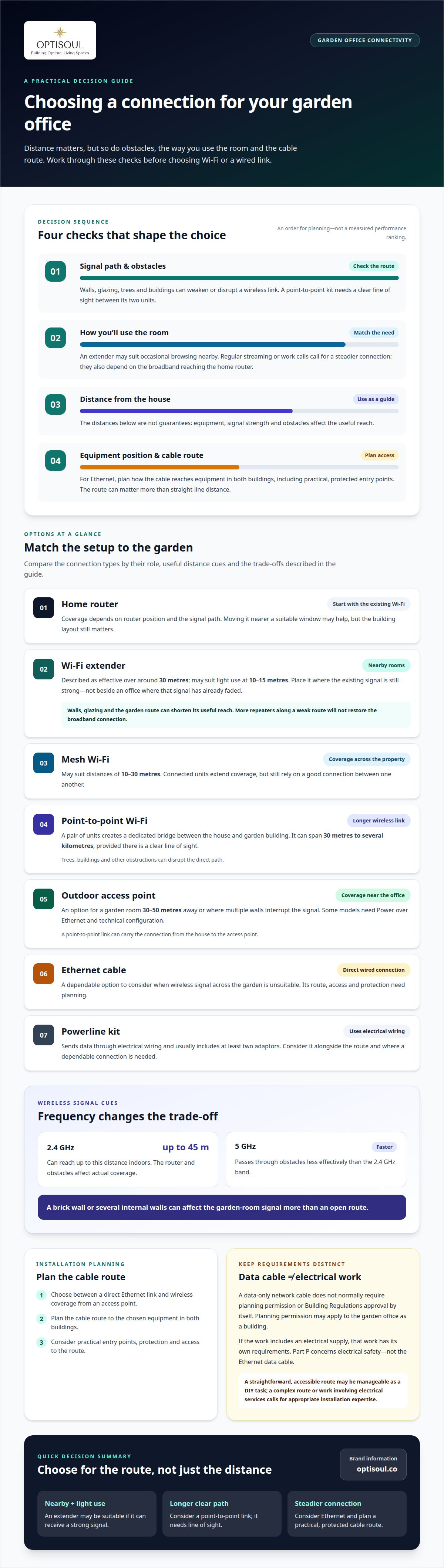
For a longer wireless link, a point-to-point Wi-Fi kit uses two units: one at the house and one at the garden building. These create a dedicated bridge between the locations rather than relying on repeaters to rebroadcast a weak signal. Point-to-Point Wi-Fi can span 30 metres up to several kilometres, provided there is a clear line of sight between both units. Trees, buildings and other obstructions can disrupt that direct path.
An outdoor access point is another option, particularly for a garden room 30-50 metres away or with multiple walls in the signal path. Some models need Power over Ethernet, which carries power and data through one cable, plus technical configuration. This can provide wireless coverage near the office, while a point-to-point link carries the connection from the house.
To make the Wi-Fi connection secure, set a strong, unique password and choose the router’s strongest available security setting. Keep the router’s administration password separate from the password used by devices. If wireless options are unsuitable, Ethernet is the most secure and reliable method; a powerline kit instead sends data through electrical wiring and usually includes at least two adaptors. Choose according to the route, signal obstacles and where you need a dependable connection.
2. Extender range and signal obstacles
A Wi-Fi extender or repeater rebroadcasts the existing signal, so its position matters. Place it where the home network is still strong, rather than beside the garden office where the original signal has already faded. Extenders are described as effective over around 30 metres, but walls, glazing and the route across the garden can shorten their useful reach. A good starting point for connecting Wi-Fi to a garden office is to assess signal strength where the extender would sit.
For light internet use, an extender may suit a garden room 10-15 metres from the house. A mesh Wi-Fi system may suit distances of 10-30 metres, using connected units to extend coverage across the property. Mesh can help when one extender leaves weak areas, but it still relies on a good connection between its units. Streaming or video calls also depend on the broadband reaching the home router, not just the signal outside.
The frequency band changes how the connection behaves. A 2.4 GHz Wi-Fi signal can reach up to 45 metres indoors, although the router and obstacles affect actual coverage. The 5 GHz band is faster, but passes through obstacles less effectively. A brick wall or several internal walls may therefore affect the garden-room signal more than an open route.
Before choosing equipment, consider the distance, obstacles and how you’ll use the room. An extender may suit a nearby office used for occasional browsing; regular streaming or work calls need a steadier connection. If an extender cannot receive a strong signal, adding more repeaters along the same weak route will not restore the broadband connection. For demanding work, a wired Ethernet cable avoids relying on the signal reaching across the garden.
3. Installation complexity and requirements
First decide whether the garden office needs a direct Ethernet connection or wireless coverage from an access point. The cable route must reach the chosen equipment location in both buildings, with entry points planned to keep the connection practical and protected. This decision affects the installation approach more than the straight-line distance between the house and office.
A data-only network cable does not normally require planning permission or Building Regulations approval by itself. Planning permission may apply to the garden office as a building, depending on the circumstances; this is separate from the cable installation. If the work also includes an electrical supply, that work has its own requirements; professional electrical contractors, such as jkcanning.com.au, illustrate the standards and planning needed when running safe power alongside modern network connections.
Part P concerns electrical safety, rather than the Ethernet data cable. The UK Government’s guidance on electrical safety sets out requirements for electrical work in dwellings. These apply to the electrical installation, not the Ethernet connection; the requirements depend on the work being carried out.
A straightforward, accessible cable route may be manageable as a DIY task, while a complex route or work involving electrical services calls for appropriate installation expertise. The route, access and chosen equipment shape the work involved. To discuss how the planned room and its connection needs fit together, share your garden-room requirements.
Optisoul Garden Rooms and Outdoor Living Spaces: Bespoke Garden Offices
Optisoul designs and builds bespoke garden offices in Weybridge, Surrey, and nearby areas. Each garden room is fully insulated and tailored to your property, intended use and style. Building Regulations requirements depend on the building and its use, so check what applies to your project. Planning for equipment and a possible cable route can be part of shaping a practical workspace.
Optisoul provides personal service and transparent quotations, with a bespoke design shaped around your needs. This gives you room to consider the garden office layout alongside your intended internet connection.
Discuss your garden-room plans with Optisoul Garden Rooms and Outdoor Living Spaces.
Plan the room around the way you’ll use it
Planning for connecting Wi-Fi to a garden office works best when you consider it alongside the room’s purpose. Think about where you’ll work, which devices need a connection and how you want the space arranged. This gives you a clearer brief for positioning a desk, equipment and possible cable entry points before the design is settled.
Whether you’re considering a bespoke garden office, garden gym or flexible garden room, the intended use can shape practical details. A workspace may need a different equipment layout from a room used for exercise or family time. Bringing those needs together early helps make connectivity part of the overall plan.
Discuss your garden-room plans with Optisoul Garden Rooms and Outdoor Living Spaces, and take the next step towards a space designed around your everyday routines.
Frequently Asked Questions
How do I install an ethernet cable to my garden building?
Use outdoor-grade Ethernet cable between the home router and a network device in the garden building. For Wi-Fi throughout the room, the device at the garden end can be an access point; a cable connected directly to a computer serves that device instead. Plan the connection around the equipment you intend to use there.
How far away from the house will a Wi-Fi extender reach?
An extender’s effective range is described as around 30 metres, but that figure is not a dependable limit for every setup. The useful question is whether the extender receives a strong enough signal at its own position to pass on. Check coverage where the extender would sit, not only in the garden office.
How far does my Wi-Fi reach?
A 2.4 GHz router signal can reach up to 45 metres indoors, but that doesn’t establish how far it will travel outdoors. The useful reading is the connection your laptop or phone receives at the place you’ll use it. Check at the desk or work area, since a strong signal elsewhere in the room may not reflect that spot.
Wired or wireless?
For flexibility, consider a hybrid setup: Ethernet can feed an access point in the office, which then connects wireless devices such as phones and laptops. A direct cable suits equipment with an Ethernet socket. This lets you choose how each device joins the network instead of treating the whole office as either wired or wireless.
What are the best ways to get Wi-Fi to a garden office in the UK?
The right approach depends on the garden layout and the connection needed at your work area. Wireless equipment may be practical along a short, open route, while a more obstructed route may need a different setup. If you’re planning a new office, include device positions and internet use in the design brief so connectivity fits the room.

Article by
Creig Franklin Rainbow Anderzon
Creig Franklin Rainbow Anderzon is the founder of Optisoul and a highly experienced builder and qualified carpenter with over 30 years in the construction industry. He specialises in designing and building bespoke garden rooms across Surrey, combining practical building knowledge with a strong eye for detail, quality craftsmanship and long-lasting finishes.
Disclaimer
Please note: This article provides general guidance only. Planning permission, permitted development rights, building regulations, costs and site requirements can vary depending on the property, location and proposed use. Always seek advice specific to your project from your local planning authority or a suitably qualified professional.
For advice about a bespoke garden room in Surrey, contact Optisoul to arrange a site survey.


